Search for the best whisky in India and a Glenmorangie Signet review sits near the top of page one, usually with a rupee figure nobody can honestly quote. Signet is a no-age-statement single malt Scotch, bottled at 46% ABV in a 700ml bottle (750ml in US-spec markets), produced at Glenmorangie Distillery in Tain, Ross-shire, and owned by The Glenmorangie Company under Moët Hennessy, part of LVMH. It reaches India as a Bottled-in-Origin (BIO) import, which is why there is no national price. Each state sets its own MRP after customs duty, state excise and corporation margin, so the only authoritative number for you is the one on your state’s current rate list.
Verification status: specifications below come from official brand pages and the Scotch Whisky Regulations 2009. Anything not confirmed against a primary source at the time of writing is flagged [VERIFY]. No state MRP figures are published here, because a stale rupee number is worse than none. What is published instead is the exact document to check for your state, and the arithmetic to compare bottles once you have that number.
Specification and availability. No tasting notes, no score. Where flavour is unavoidable, the explanation is chemical: what a high-roast malt or a virgin oak cask is documented to contribute.
Glenmorangie Signet, the documented specification
Signet sits inside a legal box before it sits inside a bottle. Under Regulation 3 of those Regulations (UK Statutory Instrument 2009 No. 2890), a single malt Scotch whisky must be distilled at a single distillery from malted barley only, in pot stills, and matured in oak casks in Scotland for at least three years. Signet meets that definition. Everything distinctive about it happens inside those constraints.
| Attribute | Glenmorangie Signet |
|---|---|
| Category | Single malt Scotch whisky |
| Distillery | Glenmorangie, Tain, Ross-shire (Northern Highlands) |
| Owner | The Glenmorangie Company, part of Moët Hennessy (LVMH) |
| Strength | 46% ABV |
| Bottle size | 700ml (700ml is standard for Indian BIO imports; 750ml is US-spec) [VERIFY which size your state list carries] |
| Age statement | None (NAS) |
| Distinguishing input | A proportion of high-roast “chocolate” malted barley |
| Cask policy | Includes Glenmorangie “designer casks”: heavily toasted virgin American white oak, air-dried, sourced from the Missouri Ozarks |
| Chill filtration / colouring | Confirm on the current official spec sheet before stating either way [VERIFY] |
Chocolate malt is a production input, not an additive. Malted barley is kilned to a much darker roast than the pale malt normally used for Scotch, a technique borrowed from dark-beer brewing. Roasting at that level drives Maillard reactions and caramelisation in the grain, generating roasted and coffee-like aromatic compounds that pale malt never develops. Few Scotch distilleries bother, because heavy roasting kills the enzymatic activity needed for conversion and caps how much of the mash bill it can make up. Glenmorangie documents its use in Signet directly; Dr Bill Lumsden, the company’s whisky creation director, has spoken publicly about the release since its 2008 launch [VERIFY launch year and current job title on glenmorangie.com].
Then the wood. Virgin American white oak that has been heavily toasted rather than charred behaves differently from a refill ex-bourbon barrel. Nothing has previously stripped the cask, so vanillin from lignin breakdown, oak lactones and wood sugars extract at higher concentrations, and colour pickup is faster. Air-drying the staves for several seasons before coopering is a specification Glenmorangie publishes as part of its wood policy [VERIFY the stated drying period and Ozarks sourcing wording, with access date].
Glenmorangie has also described Signet as containing some of its oldest reserved stock. Quote that claim only in the company’s current wording, from the current product page, with an access date. If the official page states no specific age for that component, repeat no number from anywhere else. Cadboll Estate barley appears in Glenmorangie’s material on some releases and not others, so check the live product page rather than assuming continuity across bottlings [VERIFY].
 Figure 1. Own illustration, not a brand photo. Callouts: strength, fill size, age policy, chocolate-malt component, designer-cask maturation. Source: current official Glenmorangie Signet specification page, access date printed at publication.
What “no age statement” actually means
NAS means the label declares no minimum age for the youngest whisky in the bottle. The three-year legal minimum still applies to every drop inside. A stated age must refer to the youngest component, which is why a producer blending a small quantity of young spirit into much older stock will drop the statement rather than label the whole thing at three years.
NAS is a labelling decision, not a quality signal in either direction. What it costs the buyer is comparability. An age-stated bottle lets you rank minimum maturation; NAS does not. Our guide to reading a Scotch label walks through the rest of the mandatory declarations.
Inside the distillery at Tain
Glenmorangie was licensed in 1843 by William Matheson, in a converted brewery on the Dornoch Firth. Two production details survive every rebranding.
The stills are the tallest in Scotland at 5.14 metres, roughly 16 feet 10 inches. Only the lightest vapour reaches the lyne arm, so the new-make spirit runs floral and delicate rather than heavy. Signet is that light spirit pushed into dark wood, which is the whole point of the release.
Water comes from the Tarlogie Springs, and the distillery has long marketed its production team as the Sixteen Men of Tain. LVMH acquired Glenmorangie plc in 2004, placing the distillery and its Islay sister, Ardbeg, inside Moët Hennessy.
The core range gives Signet its context: Glenmorangie Original at 10 years, Lasanta finished in sherry casks, Quinta Ruban in port pipes, Nectar d’Or in Sauternes barriques. Signet sits above all of them, and outside the age-stated logic they follow.
 Figure 2. Own illustration. Still height, lyne arm angle and reflux path, with the Tarlogie Springs water source marked. Source: glenmorangie.com distillery pages, access date printed at publication.
Glenmorangie Signet price in India and where the real number lives
Alcohol is a State List subject under the Seventh Schedule of the Constitution of India (List II, Entry 8). Every state legislates its own excise duty, its own label registration process and its own retail margin structure. Two neighbouring states can list the same 700ml bottle thousands of rupees apart. The same state can reprice it on 1 April, when most excise years turn over.
So the correct question is not what the price in India is. It is what your state’s current rate list says.
| State / UT | Authoritative price source | What to search for |
|---|---|---|
| Maharashtra | Maharashtra State Excise Department price notifications | Label name plus 700ml pack size in the imported foreign liquor schedule |
| Delhi | Delhi Excise Department published price list / L-1 schedule | Brand-and-rate list for BIO imported spirits |
| Karnataka | Karnataka State Beverages Corporation rate list | KSBCL brand code and issue price for the label |
| Telangana | Telangana Beverages Corporation Limited (TGBCL) price list | Imported foreign liquor section, current excise year |
| Haryana | Haryana Excise and Taxation Department excise policy annexures | Registered label list plus fixed retail price |
Two structural facts explain the spread. Signet is BIO: bottled at origin in Scotland and imported finished, so it carries Basic Customs Duty on top of every domestic levy. Indian-Made Foreign Liquor (IMFL) is produced or bottled domestically and never pays that duty, which is why an IMFL whisky and a BIO Scotch on the same shelf are priced on entirely different cost stacks. Second, each state adds excise and corporation margin as a percentage, so a customs-inflated landed cost gets multiplied differently in each jurisdiction. Our state excise price lists show the same label priced across five states.
Where it can legally be bought: licensed premium retail in metro cities, hotel retail where a state permits it, arrivals and departures duty-free, and Canteen Stores Department (CSD) outlets where the label is listed for eligible customers. CSD rates are set separately from civil retail and are not public in most states. Sale is prohibited outright in some states and union territories, including Gujarat, Bihar, Mizoram, Nagaland and Lakshadweep [VERIFY current status of each against the respective state notification, as prohibition rules have changed in more than one of these].
 Figure 3. Distillery, exporter, Indian importer, customs clearance under Basic Customs Duty, bonded warehouse, state label registration, state excise duty, corporation margin, retail MRP. Source: CBIC import procedure for alcoholic beverages plus one representative state’s label registration document.
Duty-free versus domestic retail
Arrivals duty-free is a separate supply chain from bonded domestic stock, priced in USD and outside state excise entirely. That is why a bottle can be absent from every shop in your city and present at the terminal. The constraint is the allowance. The Baggage Rules notified by CBIC set a limit on alcoholic liquor per eligible passenger, commonly cited as two litres [VERIFY the current litre figure and the eligibility conditions against the CBIC baggage rules text, with date checked]. The allowance covers total litres, not bottles, so two 700ml bottles and a 1-litre bottle are not equivalent claims on it. We keep a running explainer on the duty-free alcohol allowance for arriving passengers. Anything above the allowance is dutiable at the counter.
Is Glenmorangie Signet discontinued in India
Check the current Glenmorangie range page for global status, then your state corporation’s current brand-and-rate list for Indian status. They answer different questions.
An importer registers each label with each state, usually annually, and pays a registration fee. If that registration is not renewed, the label falls off the state’s list mid-cycle and cannot legally be sold there, even though the distillery still produces it and the neighbouring state still lists it. That is delisting, not discontinuation, and it is the far more common reason an Indian buyer finds a bottle has vanished. Duty-free stock sits outside that process entirely.
To verify for yourself, search the state corporation’s current rate list PDF for the label name. A retailer saying “out of stock” tells you about one shop.
Indian single malts on the same shelf
Any honest answer to the best whisky in India question has to include whisky made in India, because the domestic single malts avoid the customs layer that doubles a Scotch price before a state touches it.
| Bottle | Producer and location | Category | ABV % | Size |
|---|---|---|---|---|
| Amrut Fusion | Amrut Distilleries, Bengaluru | Indian single malt | 50 | 700ml |
| Paul John Brilliance | John Distilleries, Goa | Indian single malt | 46 | 700ml |
| Rampur Double Cask | Radico Khaitan, Rampur, Uttar Pradesh | Indian single malt | 45 | 700ml |
| Indri Trini | Piccadily Distilleries, Indri, Haryana | Indian single malt | 46 | 700ml |
| Godawan 01 | Diageo India, Alwar, Rajasthan | Indian single malt | 46 | 700ml |
Amrut released the first Indian single malt in 2004 and launched Fusion, part Indian barley and part peated Scottish barley, in 2009. Godawan is Diageo’s Rajasthan malt, sitting in the same portfolio as Talisker and Caol Ila.
Heat is the variable that separates them from Scotch. Indian warehouses lose a far larger share of each cask to evaporation every year than Scottish ones do, so extraction runs fast and stock does not survive to 18 years in commercial quantity. Age statements on Indian malts are therefore young or absent, and comparing a four-year-old Goan malt to a 12-year-old Speysider on age alone tells you nothing. Our Indian single malt guide covers the full field.
 Figure 4. Bengaluru, Goa, Rampur, Indri and Alwar plotted with each producer’s flagship expression and bottling strength. Source: producer websites, access dates printed at publication.
The five other Scotch bottles Indian shelves argue about
Four of the five share a connection: Talisker, Caol Ila, Cragganmore and Linkwood are the distilleries Diageo has publicly associated with Johnnie Walker Green Label [VERIFY the current official wording and the exact four names on the Johnnie Walker product page].
| Bottle | Distillery / region | Category | Age | ABV % | Size | Typical Indian route |
|---|---|---|---|---|---|---|
| Glenmorangie Signet | Glenmorangie, Tain, Highlands | Single malt | NAS | 46 | 700ml | Premium retail in listed states; duty-free |
| Talisker 10 | Talisker, Isle of Skye | Single malt | 10 yr | 45.8 | 700ml | The most consistently listed of the five [VERIFY] |
| Caol Ila 12 | Caol Ila, Islay | Single malt | 12 yr | 43 | 700ml | Patchy domestic listing; duty-free more reliable |
| Cragganmore 12 | Cragganmore, Speyside | Single malt | 12 yr | 40 | 700ml | Rare on state lists; duty-free or specialist retail |
| Linkwood 12 (Flora & Fauna) | Linkwood, Elgin, Speyside | Single malt | 12 yr | 43 | 700ml | Rare; often only via independent bottlings |
| Johnnie Walker Green Label | Blend of malt distilleries | Blended malt | 15 yr | 43 | 700ml | Widely listed in metro retail [VERIFY] |
All strengths to be confirmed against the current Diageo brand pages and glenmorangie.com, with access dates recorded. The availability column reflects listing patterns, not a live check of any single state list.
Talisker is peated, matured on Skye, and its 10 Year Old carries the unusual strength of 45.8%. The wider range (Storm, Distillers Edition, Port Ruighe, 18 Year Old) turns up in Indian duty-free far more often than in domestic shops. We keep a Talisker 10 spec sheet separately.
Caol Ila is the largest Islay distillery by output, and most of that output has historically gone into blends. That is why it is less famous than its Islay neighbours despite making more spirit than them. Peating intensity is measured in phenol parts per million in the malt, before distillation; quote the distillery’s published figure rather than any secondhand number [VERIFY].
Cragganmore 12 belongs to Diageo’s Classic Malts selection and is bottled at 40%. Linkwood is the harder one. Most Linkwood spirit is destined for blending, so distillery bottlings are scarce by design, and the 12 Year Old Flora & Fauna release is the reference expression. Much of what an Indian buyer will ever see carries an independent bottler’s name instead. Gordon & MacPhail, Signatory and others buy filled casks and bottle them under their own labels, at their own strengths and ages.
Johnnie Walker Green Label teaches the category distinction that matters most on this shortlist. Under Regulation 3, a blended malt Scotch whisky is a blend of single malts from more than one distillery and contains no grain whisky. That is legally distinct from blended Scotch, which does contain grain whisky, and from single malt, which comes from one distillery. Green Label carries a 15-year age statement, and it is all malt, which is why it lands on single-malt shortlists at a price point well below most 15-year-old single malts.
If a label is not on your state corporation’s list, it is not legally purchasable in that state, however many online listings appear.
The arithmetic that works without tasting anything
Price per unit of alcohol is the one comparison you can run yourself with no palate involved. Pure alcohol volume in the bottle is size multiplied by ABV.
| Bottle | Pure alcohol in a 700ml bottle | Divide your state MRP by |
|---|---|---|
| Amrut Fusion (50%) | 350 ml | 3.50 |
| Glenmorangie Signet (46%) | 322 ml | 3.22 |
| Talisker 10 (45.8%) | 320.6 ml | 3.21 |
| Rampur Double Cask (45%) | 315 ml | 3.15 |
| Caol Ila 12 (43%) | 301 ml | 3.01 |
| Linkwood 12 (43%) | 301 ml | 3.01 |
| JW Green Label (43%) | 301 ml | 3.01 |
| Cragganmore 12 (40%) | 280 ml | 2.80 |
Take the MRP from your state’s rate list, divide by the figure in the third column, and you have rupees per 100ml of pure alcohol. Signet delivers 15% more alcohol per bottle than Cragganmore 12 at 40%, which closes part of a headline price gap that looks larger than it is. A 750ml bottle at 46% contains 345ml of pure alcohol, so US-spec and EU-spec bottles are not comparable on sticker price.
The other specifications worth choosing on are all checkable on a label or a brand page: peated or unpeated, cask type, and age statement versus NAS. Virgin oak extracts vanillin and oak lactones at the highest rate because nothing has depleted the wood. Ex-bourbon casks have already given up much of that and contribute more moderately. Ex-sherry casks bring residual wine compounds and darker colour.
For most Indian buyers the binding constraint is not preference at all. Check the state list first. Shortlist second.
 Figure 5. Computed from one state’s rate list so the comparison is like-for-like. Formula printed beneath the chart: MRP ÷ (size_ml × ABV ÷ 100) × 100. State and effective date in the caption.
Signet against Blue Label and Glenfiddich
| Glenmorangie Signet | Johnnie Walker Blue Label | Glenfiddich core range | |
|---|---|---|---|
| Producer | The Glenmorangie Company (Moët Hennessy) | Diageo | William Grant & Sons |
| Category | Single malt Scotch | Blended Scotch (malt plus grain) | Single malt Scotch |
| Age | NAS | NAS | Age-stated: 12, 15, 18 |
| ABV % | 46 | 40 [VERIFY] | 40–43 depending on expression and market [VERIFY] |
| Cask signature | Includes heavily toasted virgin American oak | Blend of casks across component whiskies | 12: ex-bourbon and ex-sherry; 15: Solera vat [VERIFY] |
Signet and Blue Label are both NAS. They are not the same kind of product. Blue Label includes grain whisky and draws on more than one distillery, which places it in a different legal category under the Regulations. Our Blue Label price tracker covers that bottle separately.
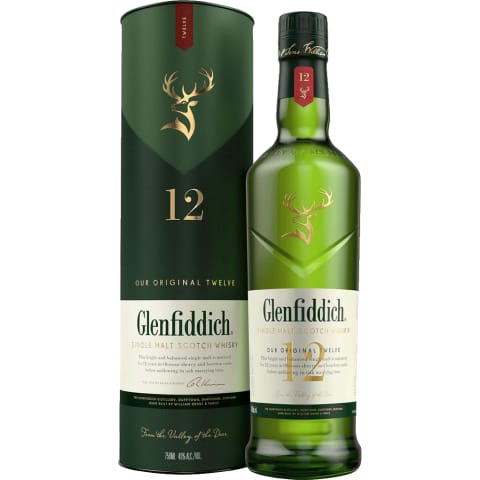
The Glenfiddich comparison is usually framed wrongly. Glenfiddich is a range with age statements at multiple price points; Signet is one expression. Comparing them means picking which Glenfiddich, then comparing on strength, age policy and cask type. See the Glenfiddich range guide for the expression-by-expression breakdown. Which is “better” is not something a specification can settle, and this article will not pretend otherwise.
Serving, storing and spotting a fake
Use a tulip-shaped nosing glass rather than a tumbler. The narrowed rim concentrates volatile compounds, which is the entire reason the shape exists. A few drops of still water lower the strength and release aromatic esters; ice suppresses them.
Storage matters more in India than in Scotland. Keep the bottle upright so the high-strength spirit never sits against the cork, out of direct sunlight, and away from the 40°C-plus swings a Delhi or Chennai flat reaches in May. Sealed and stored properly, whisky does not age in glass. Once opened, oxidation flattens a bottle over months, faster as the fill level drops.
On counterfeits, the state paperwork is your best tool. Legal stock in most states carries a state excise adhesive label or holographic strip applied for track-and-trace, alongside the importer’s details and the label registration. Buy from licensed retail, confirm the label appears on the current rate list, and treat any online seller quoting a single all-India price as a seller who cannot legally deliver.
 Figure 6. Own illustration. Mandatory declarations, importer address, batch code and the state excise adhesive label position. Source: Legal Metrology (Packaged Commodities) Rules plus one representative state excise notification.
Buying imported whisky in India and the rules that move your bill
Basic Customs Duty on imported spirits has historically stood at 150%, applied to the assessed import value before any state levy touches the bottle. The India–UK Comprehensive Economic and Trade Agreement provides for a phased reduction of that rate on Scotch whisky and gin. State the rate in force on your date of purchase from the CBIC tariff notification then in effect, and cite the notification number [VERIFY current applicable BCD rate, the CETA entry-into-force date and the step-down timetable against the Department of Commerce agreement text].
Retail prices lag tariff cuts. A state MRP is fixed for an excise year, importers hold pre-duty-cut stock, and label registrations are repriced on the state’s cycle rather than the customs one. A tariff reduction announced in one quarter can take several excise cycles to show up on a rate list.
- Permits. Some states require a personal possession or purchase permit. Maharashtra operates a permit system; Goa restricts how much liquor may be carried out of the state. Check your state’s current excise rules
[VERIFY the specific permit requirement and any fee for each state you cover]. - Interstate transport. Moving bottles across a state border beyond the permitted quantity is an excise offence, even between two states where the bottle is legally sold.
- Legal drinking age varies by state. It ranges from 18 in Goa to 25 in Maharashtra and Delhi, with 21 in Karnataka and Telangana
[VERIFY each against the current state excise rule, and note Maharashtra's separate lower age for beer and wine]. - Online sale legality varies by state. Aggregator listings that quote a national price for a BIO Scotch frequently cannot legally deliver to your address, and their prices come from no rate list at all.
What a Glenmorangie Signet review can actually prove
It can prove the strength, the fill size, the age policy, the mash bill and the cask regime, because all five are published by the producer and constrained by the Scotch Whisky Association and the Regulations. It can prove whether the label is legally on sale in your state, because the rate list is a public document.
It cannot prove that this bottle is better than an Amrut Fusion at 50%, or a 15-year-old blended malt at a third of the price. Nobody’s palate transfers. Use the specification for what it settles, and the arithmetic for the rest.
Frequently Asked Questions
What is the price of Glenmorangie Signet in India?
There is no single Indian price. Alcohol is a State List subject, so each state fixes MRP after customs duty, state excise and corporation margin, and the figure resets each excise year. The only authoritative source is your state’s current beverages-corporation or excise rate list. Arrivals duty-free is a separate, usually cheaper, channel.
What ABV is Glenmorangie Signet and does it have an age statement?
Signet is bottled at 46% ABV and carries no age statement. NAS means no minimum component age is declared, while the three-year legal minimum under the Scotch Whisky Regulations 2009 still applies to everything in the bottle. Glenmorangie’s own wording describes older reserved stock in the blend [VERIFY exact wording].
Is Glenmorangie Signet discontinued in India?
Check the official Glenmorangie range page for global status and your state corporation’s current brand-and-rate list for Indian status. A label often disappears from one state’s list because the importer did not renew its annual label registration, not because production stopped. Duty-free stock follows a separate supply chain.
Which whisky is number one in India by sales?
Volume rankings come from industry data. The Drinks International Millionaires’ Club and IWSR annual reports rank brands by cases sold, and Indian brands such as McDowell’s No.1, Officer’s Choice, Royal Stag and Imperial Blue have led global whisky volumes [VERIFY current year's ranking and source]. Best-selling is a measurable fact. Best-tasting is not.
How does Signet compare with an Indian single malt?
On paper, closely. Amrut Fusion is bottled at 50% and Paul John Brilliance at 46%, both without long age statements, both maturing in heat that extracts wood character in a fraction of Scottish time. The gap is cost structure. An Indian malt never pays Basic Customs Duty, so it reaches the shelf on a different price ladder.
Is Glenmorangie better than Glenfiddich?
That is a preference, not a fact this guide can assert. What is comparable: Glenfiddich’s core range is age-stated at 12, 15 and 18 years from William Grant & Sons, while Signet is a single no-age-statement expression with a virgin-oak component.
How much whisky can I bring into India duty-free?
The Baggage Rules notified by CBIC set the duty-free alcoholic liquor allowance for eligible arriving passengers, commonly cited as two litres [VERIFY current figure and eligibility conditions]. The limit applies to total litres, not to bottle count. Anything beyond it is dutiable at the customs counter on arrival.
Can I buy Talisker, Caol Ila, Cragganmore or Linkwood in India?
Availability differs sharply by label. Talisker 10 and Johnnie Walker Green Label are the most consistently listed on Indian state price lists; Caol Ila 12 appears patchily; Cragganmore 12 and Linkwood are largely duty-free or specialist-retail propositions [VERIFY each against current state lists]. Confirm on your own state’s rate list before travelling to a shop.
What is chocolate malt whisky?
Chocolate malt is a production input, not a flavouring. Barley malt is kilned to a high roast level, a technique taken from dark-beer brewing, which develops roasted aromatic compounds through Maillard reactions and caramelisation in the grain. It is rare in Scotch because heavy roasting reduces enzymatic activity. Glenmorangie documents its use in Signet.
Is Glenmorangie Signet cheaper at duty-free?
Duty-free stock never passes through Indian customs duty, state excise or corporation margin, which is the entire source of the gap against domestic MRP. Compare the terminal’s USD price against your state’s rate-list figure at the current exchange rate. The saving applies only within the Baggage Rules allowance.
Responsible drinking. The legal drinking age in India is set by each state and ranges from 18 to 25 [VERIFY per state]. Sale is prohibited outright in some states and union territories. Nothing here is a purchase link, and no retailer named or unnamed can legally deliver alcohol into a state where online sale is not permitted.
Review schedule. This page is re-verified quarterly, and immediately after any state publishes a new excise-year rate list or CBIC amends the spirits tariff. Treat this best whisky in India Glenmorangie Signet review as a specification document with an expiry date: the strength, the cask policy and the legal definitions hold, while every rupee figure attached to them belongs to one state on one date.
💰 prices change every month. don't overpay.
we track prices across 12 states. get the updated price list when rates change in your city.
want the full price list?
we send updated prices for every brand across 12 indian states. one email, once a month. that's it.